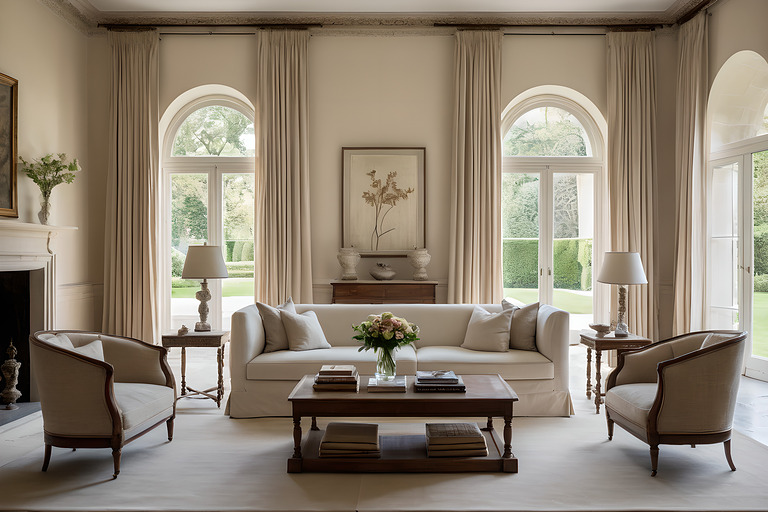
Furnishing a villa goes wrong far more often through sequence than through taste. Decisions taken in the wrong order force later ones into corners, and the piece that ends up looking like a compromise is usually the one that was chosen too early. Studios working in classic interior design, Modenese Interiors among them, run design, fit-out and bespoke joinery as one sequence for exactly that reason. What follows is the order that leaves the fewest decisions trapped, room by room.
Why sequence matters more than the shopping list
Every furniture decision removes options from the decisions that follow it. A sofa fixes the depth available in the circulation route behind it, a rug fixes the width the sofa can grow to, and a chandelier fixes the table position under it. Reversing any of the three pairs turns a free choice into a constrained one.
The rule that follows is simple to state. Decide the items that are hardest to move, hardest to reorder and hardest to change, then let the easier items adapt around them. Cost is a poor guide to sequence, because an inexpensive fixed element can constrain far more than an expensive movable one.
| Stage | What is decided | Why it comes at this point |
|---|---|---|
| First | Fitted joinery, wardrobes, panelling, fixed seating | Built into the fabric of the room and dimensionally final |
| Second | Large upholstery and dining tables | Sets circulation and every clearance in the room |
| Third | Lighting positions and control zones | Follows the furniture plan and needs wiring before finishes |
| Fourth | Rugs, curtains, occasional furniture | Adapts to what is already fixed without moving it |
The one exception worth making
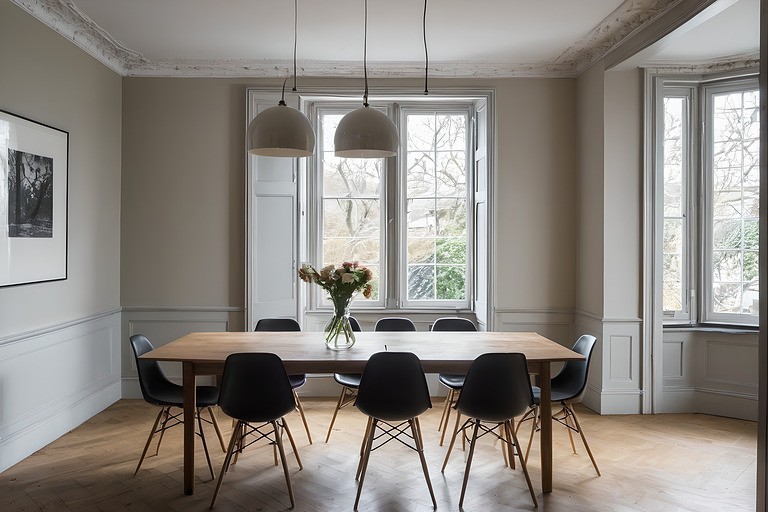
Lighting sits third in the table and first in the wiring programme, which is the contradiction that catches most projects. A pendant over a dining table needs its drop point decided before the ceiling closes, and a ceiling closes long before anybody orders a table.
The practical answer is a committed table position rather than a committed table. Fix the centre line and the seating capacity early, order the drop point against the centre line, and leave the choice of table until later. The commitment is geometric rather than aesthetic, and it costs nothing to hold.
What fitted joinery decides for the whole room
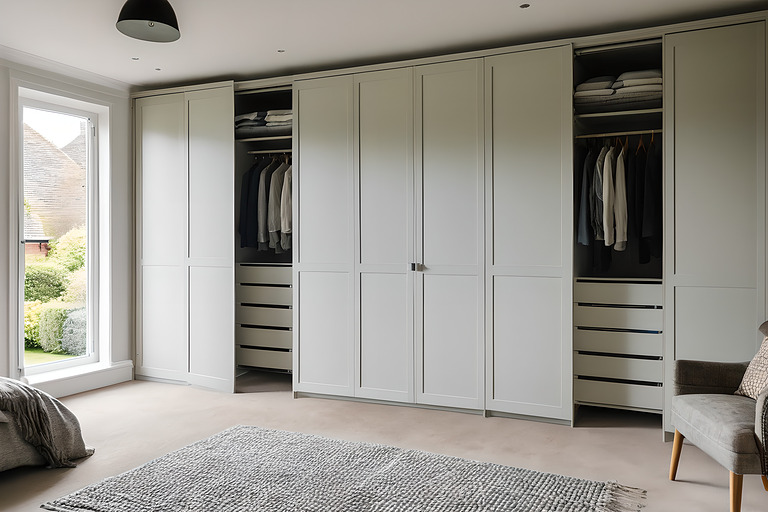
Fitted joinery is the only furniture that becomes part of the building. Its depth eats floor area permanently, its face becomes a wall plane that everything else aligns to, and its opening pattern dictates where a person can stand while using it. All three effects reach beyond the wall it sits on.
Depth is the decision with the longest reach. A wardrobe run gains hanging capacity by growing deeper, and every centimetre of depth comes out of the walking route in front of it. In a bedroom where the route also serves the bed, the joinery depth quietly sets the largest bed the room can hold.
Why large upholstery comes before everything movable
A sofa is movable in principle and fixed in practice. Its footprint sets the circulation route, its back height sets the sight lines across the room, and its seat depth decides whether people sit upright at a table height or recline below it. Nothing chosen later changes any of the three.
- Footprint against the route behind and in front of the piece.
- Back height against the sight line to a window or a view.
- Seat depth against how the room is actually used, from reading to television.
- Arm height against the side tables and lamps that will stand beside it.
Arm height is the detail that gets discovered last and matters daily. A low arm asks for a low side table, a high arm asks for a taller one, and a lamp bought for the wrong arm height either glares at seated eye level or lights the ceiling instead of the page.
What to leave until the room is standing
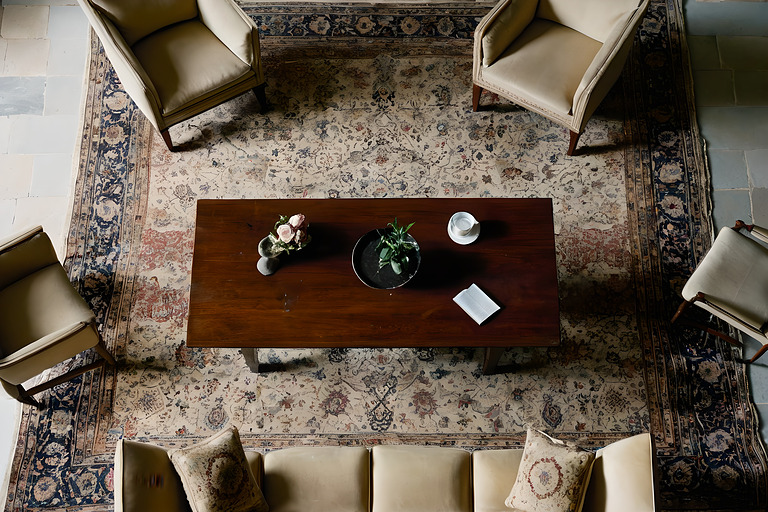
Some decisions genuinely improve by waiting, because they depend on the finished room rather than on the drawing. Colour in daylight, rug proportion against the real furniture footprint and curtain fullness against the real window reveal are all judged better in the room than in a showroom.
- Accent colour, judged against the finished floor and wall in the actual daylight of the room.
- Rug size, judged against the seating footprint once the seating stands in place.
- Occasional furniture, judged against the routes people take rather than the plan.
- Art placement, judged against the finished lighting rather than against the elevation.
How to hold a decision open without stalling the project
Holding a decision open is not the same as postponing it. An open decision has a reserved budget, a reserved lead time and a reserved position on the plan, and only the final selection stays unmade. A postponed decision has none of the three and turns into a rushed purchase.
Lead time is the part that fails first. A curtain fabric with a long delivery cannot be held open until the room is finished unless the schedule allows for it, so the honest version of holding a decision open includes checking the delivery period before the room reaches that stage.