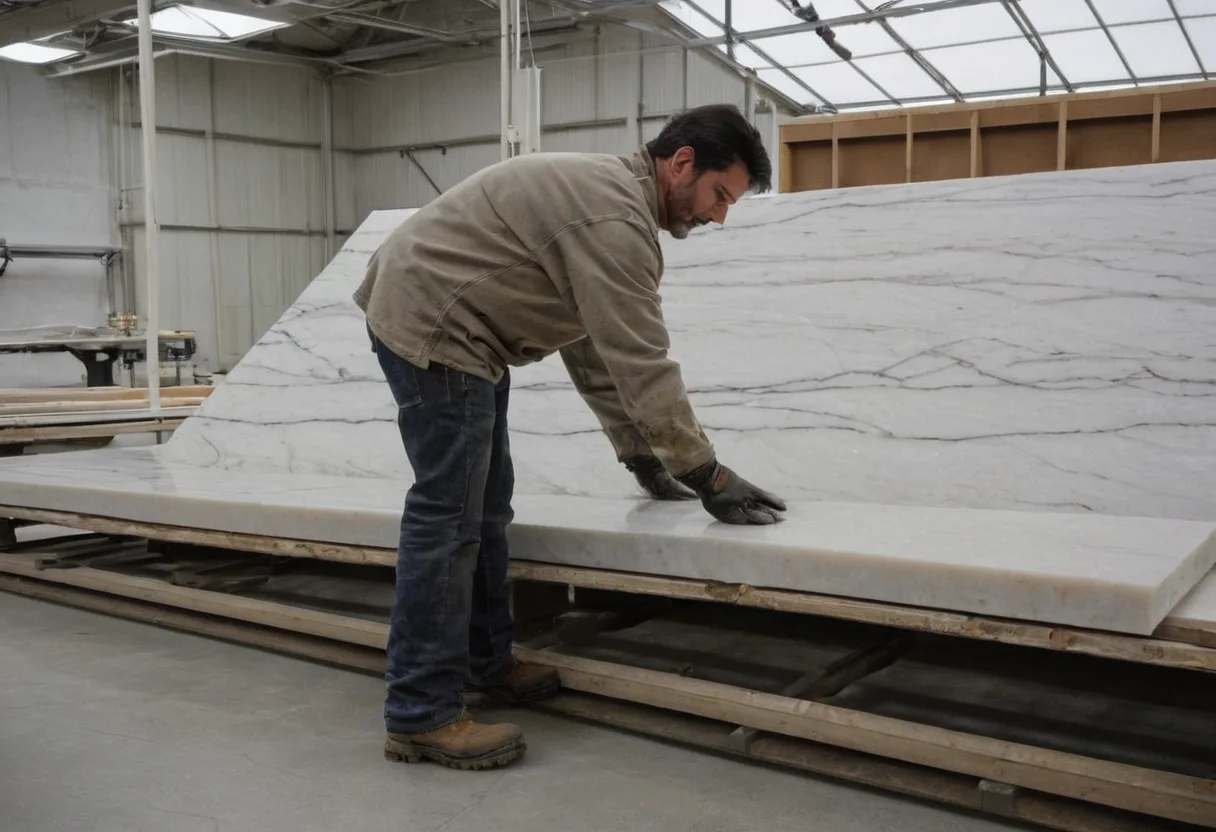
A stone wall in a finished interior is decided months earlier, in a warehouse, by someone standing in front of a rack of slabs with a piece of chalk. Natural stone cannot be ordered by code the way porcelain can, because no two blocks from the same quarry produce the same material. Selection is the design decision, and cutting merely executes it.
Why stone cannot be specified like a manufactured product
Manufactured surfaces carry a product code that guarantees consistency between samples and delivery. Natural stone carries a commercial name that describes a general appearance and guarantees nothing about a specific slab. Two deliveries of the same named marble, quarried two years apart, can differ in background tone, vein density and vein colour.
The variation has a physical cause. Marble forms through metamorphism of limestone, and the mineral impurities that produce veining are distributed unevenly through the deposit. A quarry works through a deposit over years, and material extracted at different depths and locations carries different characteristics. Background on the material is documented at marble.
The bundle, and why it governs everything
Slabs are cut sequentially from a single block and kept together as a bundle, numbered in cutting order. The bundle is the unit that matters, because sequential slabs share veining that continues from one to the next, and slabs from different bundles do not.
| Term | Meaning | Consequence for the project |
|---|---|---|
| Block | The raw extracted mass, before sawing | Determines the total material available with matching character |
| Bundle | All slabs sawn sequentially from one block, numbered in order | Reserving a bundle guarantees continuity across the whole project |
| Book-match | Two adjacent slabs opened like a book so veining mirrors across the joint | Requires consecutive slabs and a planned joint position |
| Slip-match | Consecutive slabs laid in the same orientation so veining continues | Produces a running pattern rather than a mirrored one |
| Yield | The usable area obtained after cutting around flaws and edges | Determines how many slabs must be bought for a given finished area |
Yield is the number that surprises clients. A project needing 40 square metres of finished stone rarely buys 40 square metres of slab. Allowing for cutting waste, edge trimming, flaw avoidance and the offcuts created by pattern matching, purchased area commonly runs 25 to 60 percent above finished area, and book-matched feature walls sit at the higher end.
What actually happens during a selection visit
Slab selection takes place in a warehouse and follows a repeatable sequence. Clients attending for the first time frequently expect a showroom experience and find an industrial one.
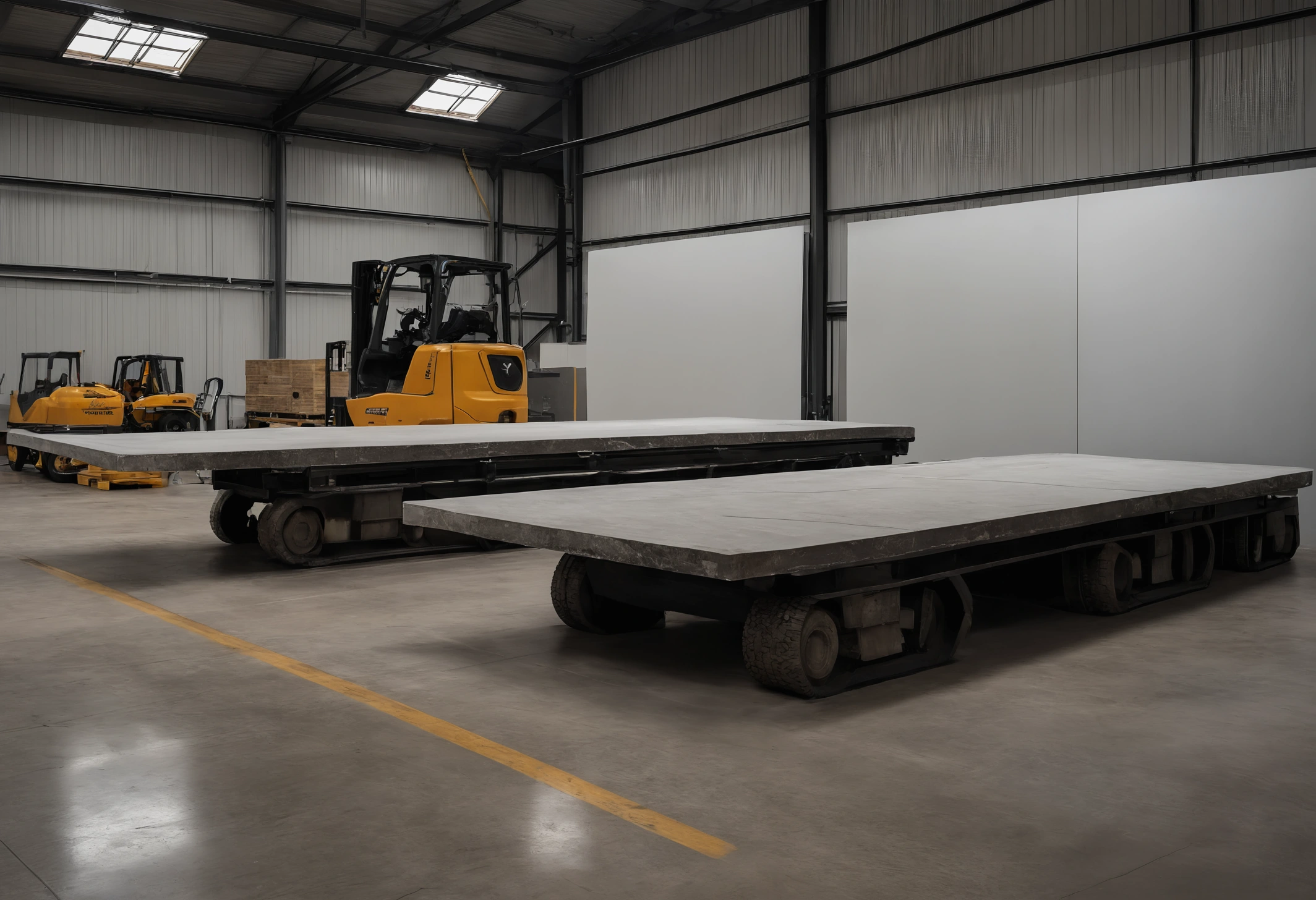
- Slabs are stood and separated. A forklift or overhead crane opens the rack so each slab can be seen face on rather than edge on.
- Water is applied. Wetting the surface approximates the appearance of a honed or polished finish and reveals veining that a dry slab hides.
- Slabs are photographed straight on. Photographs taken square to the face, with a scale reference, become the record used for layout planning.
- Reservation is marked. Selected slabs are chalked and tagged, and the bundle is held for a defined period, commonly 2 to 6 weeks.
- Layout is planned on the photographs. Cutting positions are drawn on the images before any saw touches the material.
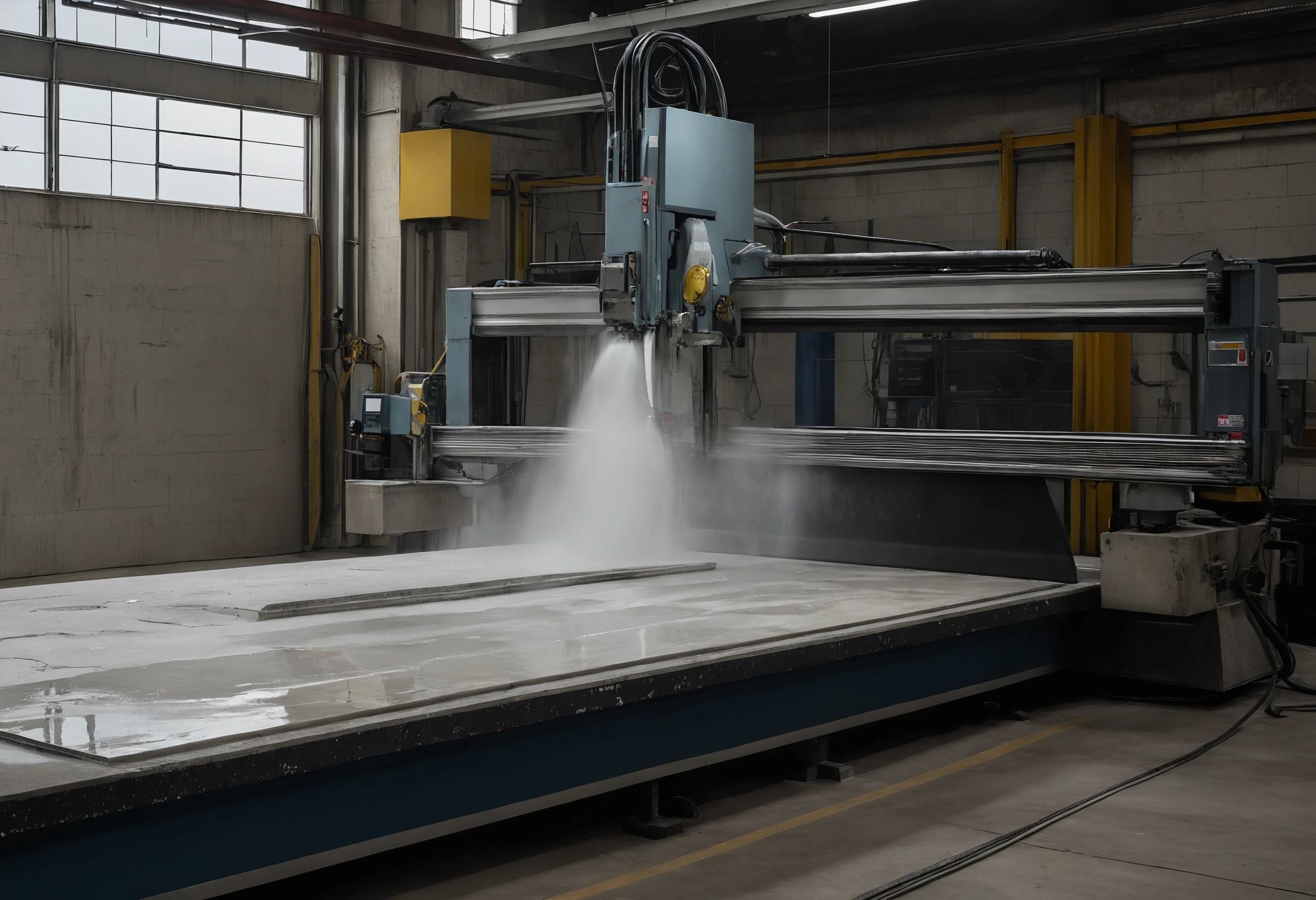
The saw is the last decision, not the first. Everything that determines how a stone wall looks has already happened by the time the material is cut.

How a book-matched wall is planned
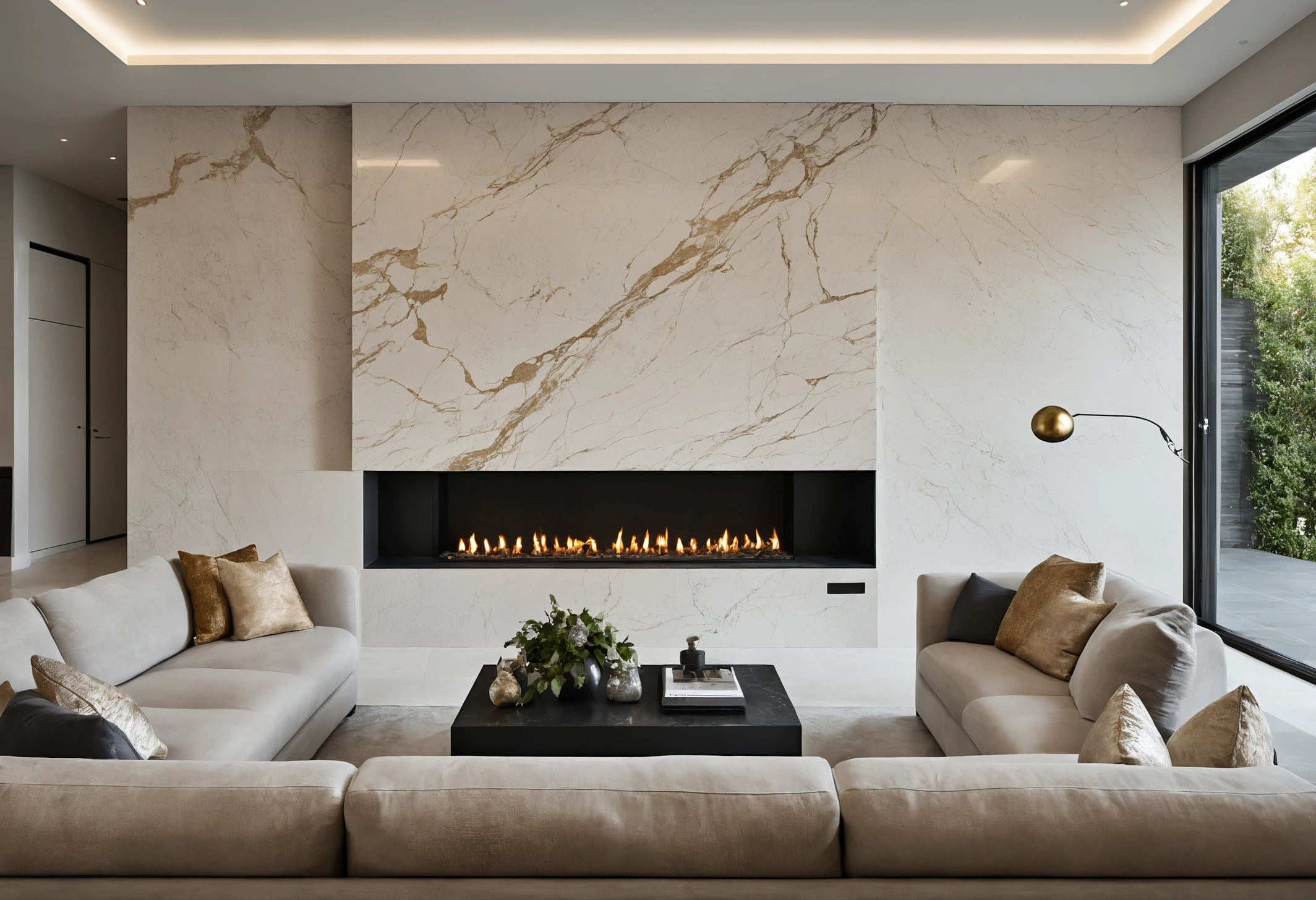
A book-matched feature wall requires four decisions taken together: which consecutive slabs, where the mirror joint falls, how the pattern relates to the room's centre line, and where cut-outs for sockets, switches or joinery will land.
Cut-out position is the detail most often missed. A socket placed in the centre of a dramatic vein destroys the effect that justified the material's cost, and moving a socket 300 mm during construction is trivial while moving it after installation is not. Coordinating stone layout against electrical layout before cutting is the single highest-value hour in a stone package.
- Mirror joint
- The vertical line where two book-matched slabs meet. Placing it on a room's centre line produces symmetry; an intentional offset has to be resolved through visual balance rather than automatic symmetry.
- Pattern scale
- Bold veining suits large uninterrupted surfaces. The same slab cut into small panels loses the pattern entirely and reads as noise.
- Directionality
- Some stones have a clear vein direction. Rotating a slab 90 degrees to fit a wall changes the material's character completely.
Finish changes the material as much as the stone choice does
Surface finish alters colour, reflectivity, slip resistance and maintenance behaviour. The same slab in four finishes reads as four different materials, which means finish selection deserves its own decision and a place in the bathroom material hierarchy rather than being treated as a default.
| Finish | Appearance | Practical behaviour |
|---|---|---|
| Polished | Reflective, deepest colour saturation | Shows etching and scratches most clearly |
| Honed | Matte, softer colour | Hides scratches better; more absorbent without sealing |
| Leathered | Textured, low sheen | Conceals marks well; harder to clean in the texture |
| Brushed | Slight relief following the stone's softer minerals | Good slip resistance; tactile |
| Sawn or flamed | Rough, matte, lightest colour | External use; high slip resistance |
Marble and limestone react to acids regardless of finish, which is the property that determines where each material can be used. Citrus juice, wine and many cleaning products etch calcium carbonate surfaces, producing dull marks that are not stains and cannot be cleaned away. In a kitchen planned for active shared use, that behaviour argues for a different material or for accepting patina as part of the surface's character.
Alternatives worth considering before committing
Three material families compete with marble in contemporary interiors, and each solves a different problem that marble does not.
- Quartzite: a natural stone considerably harder than marble and not acid sensitive in the same way, with veining that can approach marble's character.
- Sintered stone: a manufactured material with consistent pattern between slabs, high resistance to heat and staining, and no natural variation to select.
- Travertine: a porous sedimentary stone with a warm tone and open texture, used both internally and externally, filled or unfilled.
The choice between natural variation and manufactured consistency is a genuine design decision rather than a quality question. A client who wants an exactly repeatable surface across a large area is better served by a manufactured product, and a client who wants a surface nobody else can duplicate needs natural stone with all of its selection work.
How stone selection fits an interior programme
Stone selection has to happen early because the material governs other decisions and carries its own lead time. Reservation periods expire, blocks are sold to other buyers, and a bundle lost in week six cannot be recovered by paying more in week twelve.
A workable sequence places stone selection immediately after layout approval and before joinery detailing, since joinery has to meet the stone rather than the reverse. Studios delivering luxury interior design in Dubai typically build slab selection into the programme at the same stage as structural decisions, because both categories close off options for everything downstream.
Furniture selection follows stone rather than leading it. A dramatic stone wall changes what upholstery can sit against it, and the reverse rarely holds. Buyers choosing Italian furniture for a room with a strong stone element usually bring a photograph of the selected slab to the showroom, which makes the comparison concrete rather than remembered.
Three questions before signing off a stone package
Ask whether the slabs have been physically reserved and until what date. Ask whether the quantity purchased includes an allowance for yield loss and pattern matching, and what that allowance is as a percentage. Ask to see the cutting layout drawn on photographs of the actual reserved slabs before fabrication begins.
All three answers exist in any competently run stone package. Their absence indicates that the material has been ordered by name rather than selected as an object, which is the point at which a client discovers that the stone they receive and the stone they imagined are different materials sharing a commercial description.